Estrogen Dominance

What is Hormone Imbalance?
Hormone Imbalance is an important health issue for women today. Hormone Imbalance can adversely affect a woman in any season of her life, from her cycling years, through menopause, and into the postmenopausal years. Contributing factors include prescriptive Synthetic Hormones (with undesirable side effects), foreign Estrogen prevalent in our diet and environment and improper use or misapplication of Natural Progesterone Creams.

In order to understand how Hormone Imbalance begins, it is useful to look at the normal menstrual cycle (see chart given overleaf).

Estrogen dominates the first half of the menstrual cycle and prepares the ovaries for ovulation. It also causes the buildup of the endometrial lining of the uterus. Estrogen further prepares the body to sustain another life by triggering the storage of fat, water, sodium, fiber, and other nutrients. Estrogen levels peak, mid cycle, at ovulation.
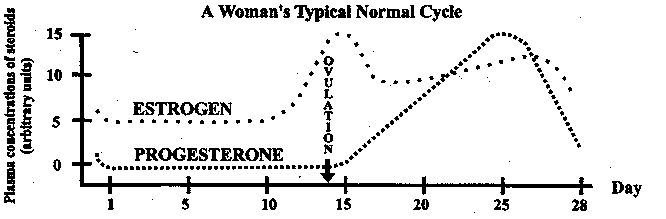
Progesterone is not produced by the ovaries until after ovulation. Progesterone is responsible for maintaining and "ripening" the uterine lining so that it is receptive to implantation should pregnancy occur. If no pregnancy occurs, a drop in Progesterone (and Estrogen) levels activates menses to flush out the uterine lining and causes the body to eliminate the extra nutrients it has stored - and the cycle begins again.


Hormone Imbalance in most women today are the result of Estrogen levels becoming excessive and / or Progesterone levels becoming deficient. Problems can begin when the stored fat, fiber, water, and nutrient buildup (produced by Estrogen) are not regularly and sufficiently eliminated. Eventually, this can lead to problems such as bloating, water retention, weight gain (refer Appendix "A" for Positive Weight Release), depression, fibroids, etc. This phenomenon, known as Estrogen Dominance, has become widespread in recent decades due to extreme changes in the lifestyle and environment of women in the industrialized world.

As women of all ages become increasingly aware of these problems, many are finding that they feel healthier, more energetic and younger when they address their Hormone changes with gentle, Natural Herbal Dietary Supplements.
How do Women Become Estrogen Dominant ?
Today we are continuously surrounded by new environmental compounds called xenoestrogens. Xenoestrogens, which are primarily petrochemical, have a very potent estrogen - like activity. They are in our air, fuels, pesticides, herbicides, fungicides, plastics, clothing, bug / mosquito sprays and personal care products.

Our diet is also contaminated with hormones. Synthetic oestrogens are now used to fatten cattle, as well as other meat-producing animals, and to increase milk and egg production. Most of us are ingesting Hormones in many of our meals.

Use of Synthetic Estrogens: Estrogen dominance problems can be exacerbated by the use of Synthetic Estrogens in the form of birth control or hormone replacement pills. Synthetic Hormones have molecular structures that are not compatible with our physiology. We do not have enzymes designed to modify their effects, nor can they be efficiently excreted.


Therefore, these synthetics can have an unnatural and far more potent hormonal effect on our body systems than Natural Hormones.

Not Ovulating: Women in their early to mid thirties, as they begin to approach menopause, have an increased frequency of anovulatory cycles, that is, cycles in which ovulation does not take place. ( Women may continue to have periods even though they may not be ovulating.) When ovulation does not occur, no Progesterone is produced by the ovaries. Premenopausal women may therefore experience some of the estrogen dominance symptoms (described on the previous page) because they may not be producing the levels of Progesterone needed to balance the effect of Estrogen. Use a Fertility Thermometer to check your date of ovulation.

Menopause: It is a little known fact that Estrogen levels in women whose ovaries are no longer functioning will remain at approximately 40% of their former levels. This is because most women continue to produce estrogen by conversion of androgens (derived from the adrenal gland) into estrogen in the fat cells. Progesterone levels, however, drop to almost zero (1/120 of the former levels).

Symptoms of Estrogen Dominance
Allergies, Breast tenderness, decreased sex drive, depression, fatigue, fibrocystic breasts, foggy thinking, increased risk of stroke, infertility, miscarriage, PMS, rapid increase in weight, uterine cancer and fibroids to name a few.

If the body has a proper balance of Progesterone to Estrogen, many of these symptoms as well as menopausal symptoms can be alleviated.

The Menstrual Cycle


THE MENSTRUAL CYCLE
The menstrual cycle is the process of ovulation and menstruation in females. There are about 28 to 35 days in a normal menstrual cycle, with ovulation occurring on one of the 11th to 15th days.


6 days after menstruation, the ovaries start to secrete oestrogen, prompting the uterine lining to start repairing and thicken for preparation of the fertilised egg. The uterine lining is richly supplied with blood capillaries to nourish the egg.

After the 14th day, the egg is released from the ovary. Progesterone is secreted to help maintain the uterine lining should the egg be fertilised. If the egg is not fertilised by the 25th day, progesterone is no longer supplied and the uterine lining breaks down.  The whole cycle is then repeated again.

As shown above, oestrogen and progesterone play a major role in the menstrual cycle. Women who suffer from fertility problems are shown to have a low level of progesterone to help maintain the uterine lining which provides support to the fetus, or low amounts of oestrogen. 

Oestrogen and Progesterone - The Big Two

OESTROGEN AND PROGESTERONE 
In the female hormonal system, mainly there are 2 hormones that are responsible for the growth and maintenance of secondary sex characteristics. These two hormones, oestrogen and progesterone, have different uses.


Oestrogen is the primary female sex hormones and is made of a group of compounds. They are secreted through the ovaries and have a wide variation of purposes. Some of these include:
  •           Growth of uterine lining
  •           Determining the gender of a baby (with a higher level of oestrogen, the fetus is then feminized. However, if the level of testosterone in a fetus is higher than the oestrogen level, the fetus is masculinised.)
  •           Improvements in the quality of skin
  •           Acceleration of metabolism
  •           Increasing cholesterol levels in bile

On the other hand, progesterone, like oestrogen, is a steroid hormone. It is also produced by the ovaries. However, its functions differ from those of oestrogen.
  •           Maintenance of the uterine lining to receive a fertilised egg
  •           Causes discomfort during pregnancy (as more space is required for the gestating fetus, the muscles in the uterus are more relaxed, prompting discomfort in the bladder, digestive system and the rectum)
  •           Prevention of endometrial cancer
  •           Signalling of insulin release
Sources: 


Diabetes

DIABETES


http://www.lchdhealthcare.org/information/diabetes-information/


If the amount of insulin present in the body is extremely low, diabetes occurs. Diabetes is a chronic disease where the amount of sugar present in the body is extremely high due to the lack of insulin.

In Type 1 Diabetes, the body does not produce any insulin at all. Hence, patients have to follow a special diet and take insulin injections for the rest of their lives. They also have to take regular blood tests in order to maintain a regular sugar level.


However, in Type 2 Diabetes, the more common of the two, the body either does not produce enough insulin for the body, or the body does not react to insulin. People with Type 2 Diabetes can manage it by exercising regularly, losing weight and following a healthy diet. That does not mean that diabetes is completely eradicated from the system. Instead, these methods only serve to help manage it. Type 2 Diabetes is a progressive disease and gets worse as we grow older. Eventually, people with this disease will have to take insulin in the form of a tablet. 


Sources:
http://biomed.brown.edu/Courses/BI108/BI108_2002_Groups/pancstems/stemcell/insulin_glucagon.htm
http://www.medicalnewstoday.com/info/diabetes/

How Hormones Regulate Blood Sugar Levels

To maintain a constant blood-glucose level, your body relies on two hormones produced in the pancreas that have opposite actions: insulin and glucagon.

Insulin and glucagon have opposite effects on liver and other tissues for controlling blood-glucose level.

Glucagon is a hormone produced by the pancreas to regulate blood sugar levels. It works with insulin to help achieve a balanced sugar level in the bloodstream by prompting the liver to release more glucose when blood sugar levels are low. This occurs usually after exercise and in between meals.

Insulin is made and secreted by the beta cells of the pancreatic islets, small islands of endocrine cells in the pancreas. Insulin is a protein hormone that contains 51 amino acids. Insulin is required by almost all of the body's cells, but its major targets are liver cells, fat cells and muscle cells. For these cells, insulin does the following:
  • Stimulates liver and muscle cells to store glucose in glycogen
  • Stimulates fat cells to form fats from fatty acids and glycerol
  • Stimulates liver and muscle cells to make proteins from amino acids
  • Inhibits the liver and kidney cells from making glucose from intermediate compounds of metabolic pathways (gluconeogenesis)
As such, insulin stores nutrients right after a meal by reducing the concentrations of glucose, fatty acids and amino acids in the bloodstream. Insulin is only released when blood sugar levels are high.


http://science.howstuffworks.com/life/human-biology/diabetes1.htm

Effects of Hormonal Imbalance

Effects of Hormonal Imbalance
In endocrine glands such as the pituitary gland, the thyroid and the thymus, a small amount of hormone can make a big difference. If left unchecked and untreated, hormonal imbalance can cause serious health risks. For example, should there be a lack of oestrogen or progesterone, these effects occur:
  •           Fatigue or insomnia
  •           Severe mood swings
  •           An irregular menstrual cycle
  •           Increased risk of osteoporosis and heart disease


In addition, with a higher amount of testosterone in a woman’s body, a woman is more likely to grow facial hair, an increased level of aggression and acne. On the other hand, if a man is lacking in testosterone, his body is unable to develop fully during puberty. The body suffers from bone loss, problems with body composition and muscle problems.

Thyroid imbalances can cause a shift in metabolism, in which the rate of metabolism drops.
Hormonal imbalance can be corrected through medication or prescriptions. However, before purchasing these medications, they should consult a physician to ensure that it is safe to consume these dosages. 

Sources:
http://en.wikipedia.org/wiki/Hormone_imbalance
http://karenrothnutrition.com/articles/physical-and-emotional-effects-of-hormone-imbalance
http://www.ehow.com/about_4601867_effects-hormonal-imbalances.html

Causes of Hormonal Imbalance

Most Common Causes of Hormonal Imbalance

Hormonal imbalances are becoming more and more common in younger women. But doctors still aren’t sure how to handle these changes and are often reticent to label them hormonal imbalances. Doctors generally focus on symptoms rather than causes and this can often get in the way of resolving problems that present themselves through hormonal shifts. Without hormonal testing many women deal with symptoms and misdiagnoses that leave the condition unresolved and risk their overall health. This could lead to heart problems, weight problems, infertility and the risk of death from conditions such as Polycystic ovarian Syndrome (PCOS), endometriosis, breast, uterine, and ovarian cancers.

What Causes Hormonal Imbalance?


1. Stress:
This can be everyday stress but it can also be more extreme stress such as emotional or physical abuse. Stress raises cortisol levels in the body which in turn makes the body produce excess amounts of other hormones to cancel out the cortisol. This is a common cause of the memory issues associated with hormonal imbalance.


2. Diet: Eating too many of the wrong foods can affect the way your body produces hormones. Certain foods help encourage the production of progesterone and others decrease it. If you don’t eat a diet rich in fruits, vegetables and lean protein like chicken, there’s a good chance it will affect your hormonal levels. Processed foods are especially negative to the system. By the same turn if you do not eat enough you can do just as much damage. Eating disorders, such as anorexia and bulimia, are also equally harmful to the hormonal balance.


3. Cancer: Certain cancers such as breast, ovarian and uterine cancers feed off of hormones and therefore cause an imbalance in the body’s hormones as they grow.


4. Exercise: You need to find a healthy balance when exercising. If you don’t get enough, your body is unable to produce enough hormones to regulate your body’s function. On the other hand, if you get too much you are likely to be reducing hormonal production due to a lack of cholesterol to make the right steroidal hormones.


5. PCOS: Polycystic Ovarian syndrome is a condition that causes the ovaries to produce too much androgen in the body. Androgen is a hormone that stimulates growth of male secondary sex hormones. This means that the woman may exhibits symptoms like weight gain, excess hair on the face and body, irregular periods and infertility.


6. Hormonal Supplements: Taking a birth control pill or other forms of hormonal supplementation can throw the balance of your body off. Such examples include using contraceptive pills, a NuvaRing and medication.


7. Environmental Toxins: Pesticides and contaminants found in food can alter the way your body produces hormones. Petrochemicals can cause bind to the receptors in your body that detect estrogen and thereby alter the way your body produces estrogen and its balance with other hormones in the body.

Hormonal testing is important to determine if you have a hormonal inbalance If you feel that you may be experiencing the effects of a hormonal imbalance, it is best to talk to your doctor and establish if you exhibit symptoms. From there, your doctor should be able to recommend a good endocrinologist who can better evaluate your symptoms and conduct testing to establish a cause.

What are Hormones?

Hormones are chemicals released by cells, glands or organs to send signals which affect the way the body works. A small amount of hormones makes a big difference. Essentially, hormones are chemical messages sent by the body as signals.

There are two types of hormones: endocrine hormones and exocrine hormones. Endocrine hormones are released directly into the bloodstream from glands or cells, while exocrine hormones are secreted into a duct and transported to the bloodstream, or diffused from one cell to another by the process of paracrine signalling. 

Hormones are used to stimulate growth, repair, regulation of processes and controlling of the rate of certain activities within the body. Although they cannot be seen with the naked eye, hormones play an important role in the human system. 

Sources:

http://www.news-medical.net/health/What-are-Hormones.aspx
http://en.wikipedia.org/wiki/Hormone